Industrial Forklift Batteries: Flat Plate vs Tubular Batteries 101
 Jason Poston : Nov 13, 2026, 5:00:00 AM
Compare flat plate and tubular batteries to find the best forklift battery for your fleet based on cost, lifespan, and long-term ROI.
4 min read
Lead acid forklift batteries can opportunity charge.
That surprises people, because much of what’s written online says otherwise. Opportunity chargers built for lead acid batteries have been on the market since the 1990s, and many multi-shift operations run on them today.
One caveat most articles skip: opportunity charging works a battery harder than a full charge and cool-down cycle. A battery sized for opportunity charging will perform well through its 60-month warranty. Even so, partial charges wear the plates faster than one full charge and cool-down each night. For that reason, we don’t sell the same battery for both jobs. When an operation plans to opportunity charge, we spec a higher amp-hour battery than we would for a standard charging plan. The added capacity keeps the battery performing for the life of the warranty.
So the choice between battery changing and opportunity charging has nothing to do with which chemistry you own. Both plans keep a lead acid fleet running, each plan is the right call in many facilities, and which plan fits yours comes down to how your trucks work. Here is how each plan earns its place.
Forklift battery charging comes down to two approaches.
Battery changing is the conventional plan, and the right plan for many fleets.
The truck runs until the battery reaches its rated depth of discharge. The operator pulls into the battery room, a battery handling system removes the discharged battery out and sets a charged battery in, and the truck returns to work while the discharged battery takes a full charge and cools. Every battery gets the complete charge cycle the manufacturer designed for, every time.
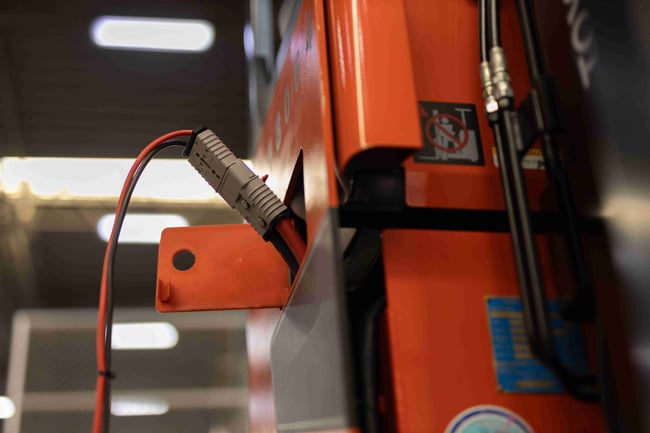
Opportunity charging keeps the battery in the truck.
Instead of running to depth of discharge, the operator plugs in during breaks, lunch and shift changes. Each charge is short, but there are enough charges through the day to keep the battery topped off. One battery carries the truck through multiple shifts and never leaves the compartment. Once a week the battery gets a full equalization charge to balance the cells.
A three-shift operation moving heavy loads all day can draw more energy from a truck than one battery can take back through opportunity charging. Battery changing answers that with a second or third battery per truck, each battery fully charged and cooled before the next change.
Other places battery changing is the strong choice:
The batteries get the gentlest possible service life. Full charge, full cool-down, every cycle. For a fleet that owns its batteries and wants the longest service life from them, that matters.
The chargers are simple and inexpensive. Conventional chargers have been around as long as lead acid batteries. They cost less to purchase and about the same to install than opportunity chargers.
A well-run battery room is fast. With the right battery handling equipment, a trained operator completes a change in 8-10 minutes and the handling system does the lifting. We represent that equipment, we install it, and we support rooms that keep pace with all three shifts.
The infrastructure may already be in place. If the facility has a battery room today, the room is paid for and the crew knows the routine.
Two things to plan from the start: the battery has to be sized for opportunity charging, which means a higher amp-hour battery, and the weekly equalization charge has to stay on the schedule. Both are routine once they are built into the plan.
Charging lead acid batteries releases a small amount of hydrogen, so charging areas need adequate airflow. Most facilities already have enough air turns in the general space to meet the requirement without changes. The one case that needs a closer look is charging equipment inside a closed-off room, and we check that during the site assessment before anyone buys anything.
A single-shift operation needs one battery and one charger per truck under either plan. The battery runs a shift, charges and cools overnight, and goes back out. Conventional chargers cost less, so battery changing with one battery per truck is usually the more economical plan for one shift.
Add a second or third shift and the economics change. Under battery changing, each added shift means another battery per truck plus the room and equipment to manage those batteries. Under opportunity charging, each truck still has one battery, and the added costs are the higher-capacity battery and the opportunity chargers. For many multi-shift fleets, opportunity charging costs less. For the heaviest fleets, where one battery cannot keep up even with opportunity charging, battery changing still wins.
The crossover point is different for every operation. Load weight, travel distance, real hours of movement per shift and the actual length of the breaks all move it.
Plenty of charging plans get chosen from a walk-through, and some of them turn out fine. But a walk-through can only tell you what the trucks look like at rest. How hard they work, how long they sit and how much charge is left at the end of a shift are things you have to measure. Without those numbers, the plan is an educated guess.
A power study puts small monitors on your trucks for about two weeks. The monitors record how hard each truck works, how long each truck sits, where the trucks park, how much charge is left through the day and whether batteries get back on a charger when they should. Then we model battery changing and opportunity charging against your real numbers, with the right battery spec for each plan, and show you what each plan costs and delivers over the life of the equipment.
Sometimes the answer is a well-equipped battery room. Sometimes the answer is opportunity chargers at the break room door. We offer both, and the study tells us which one to recommend.
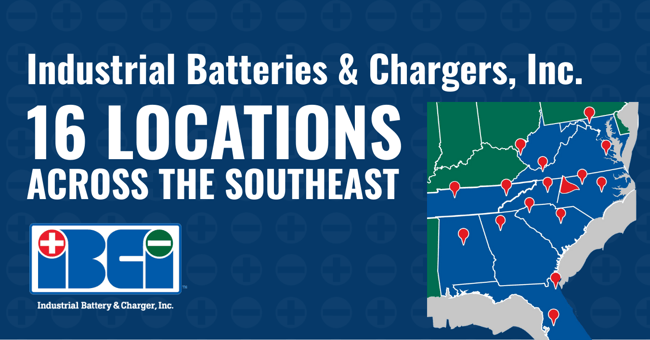
Schedule a free power study, or reach the IBCI location nearest you:
Alabama - Birmingham
Florida - Jacksonville and Lakeland
Georgia - Atlanta
Maryland - Hagerstown
North Carolina - Charlotte, Conover, Kernersville, and Wilson
South Carolina - Camden and Greer
Tennessee - Knoxville and Nashville
Virginia - Richmond and Salem
West Virginia - Nitro


Stay informed by subscribing to the Electric Forklift Fleet Power blog.
Explore expert insights, safety tips, and power system guidance to help keep your electric forklift fleet efficient, productive, and running strong.
Jason Poston : Nov 13, 2026, 5:00:00 AM
Compare flat plate and tubular batteries to find the best forklift battery for your fleet based on cost, lifespan, and long-term ROI.
Meet Air Force veteran Ricky Whitehouse and discover how IBCI supports veteran job opportunities through training, mentorship, and long-term career...
Jason Poston : Oct 30, 2026, 9:26:29 AM
Lead acid or lithium ion forklift batteries? The right answer depends on your application, shifts and charging windows. Here’s how IBCI matches the...
 Jason Poston : Nov 13, 2026, 5:00:00 AM
Compare flat plate and tubular batteries to find the best forklift battery for your fleet based on cost, lifespan, and long-term ROI.
 Jason Poston : Oct 30, 2026, 9:26:29 AM
Lead acid or lithium ion forklift batteries? The right answer depends on your application, shifts and charging windows. Here’s how IBCI matches the...
Optimize your electric forklift fleet with real data. Learn how power studies improve efficiency, reduce costs, and extend forklift batteries.