 Jason Poston

How Long Should a Forklift Battery Last?
How long should a forklift battery last? It depends on your application, shifts and charging windows, and none of that is on the spec sheet. Here’s...
Search “lead acid vs lithium ion forklift batteries,” and you’ll get pages of articles that all say the same thing.
Lithium ion lasts longer, charges faster, and needs no maintenance. Lead acid is the forklift battery you choose when the budget won’t stretch.
Then talk to somebody who actually runs a forklift fleet. Plenty of three-shift warehouses are running flooded lead acid and finishing every shift. Plenty of single-shift operations bought lithium ion forklift batteries and are paying for capacity that sits on a charger all afternoon. In each case the chemistry wasn’t wrong. It was matched, or mismatched, to one specific operation.
If you’re trying to choose between lead acid forklift batteries and lithium ion forklift batteries, there’s a lot to consider. It’s the kind of decision we help customers make every day. Keep reading for our point of view on how to decide.
When a customer asks us “lead acid or lithium ion?”, we answer with questions of our own:
What’s the application? Load weight, lift height, travel distance, grade and temperature all decide how much energy a truck draws per move. A truck in a freezer working a ramp draws power very differently than one moving empties across a flat floor, and the battery that suits one may not suit the other.
How many shifts, and how many hours in them? Three shifts on the schedule often turn out to be five or six hours of actual movement once you measure it. The number on the schedule and the number on the truck decide different things.
Where are the charging opportunities? A full eight hours on the charger plus eight to cool is one kind of operation. Twenty minutes at lunch and fifteen at every break is another. Whether there’s a battery change-out room, or the battery lives in the truck for good, changes the math again.
Together, those three answers tell us how much work the fleet needs from its batteries and chargers each day. That amount of work is called throughput, and it’s what actually separates a good battery choice from an expensive one.
A spec sheet tells you a battery’s rated capacity and, usually, a cycle count. Neither one tells you whether a truck gets through second shift.
Throughput does. It’s the energy moving into and out of the battery over a working day, measured against what the battery can hold and how fast it can take a charge. Two identical trucks, one on flooded lead acid and one on thin-plate pure lead (TPPL), will not deliver the same usable runtime from the same charging windows, because TPPL moves energy through more efficiently. Cycle count can’t see that difference. Throughput can.
Once we know the throughput an operation needs, chemistry becomes a fit question instead of a faith question. That’s where the comparison belongs.
Rechargeable lead acid is more than 150 years old, which makes it older than the typewriter and the Nobel Prize. It’s still the most common forklift battery on the market for good reasons.
Cost. After a century and a half of manufacturing, lead acid is the least expensive forklift battery you can buy, often by a factor of two or three against lithium ion.
Predictability. The chemistry is thoroughly understood. It follows known patterns, and when something goes wrong, most technicians can diagnose and repair it.
Recyclability. Lead acid batteries are recycled at a rate of about 99 percent, with the recovered lead and plastic going into new batteries. One of our customers passed on lithium ion specifically because they couldn’t get a clear answer on its end-of-life path, and went with sealed lead acid instead.
Where lead acid asks something of you is charging and maintenance. A flooded battery wants a full charge and a cool-down, which fits a single shift or a change-out program well and fits opportunity charging when managed correctly. It also needs watering and scheduled equalizing, and it holds sulfuric acid, so handling procedures and PPE are part of owning it. None of that is a flaw. It’s the operating cost of the lease expensive battery on the market, and for a lot of fleets it’s well worth paying.
Thin plate pure lead is still a lead acid battery, but sealed, and built with thinner, purer plates. It charges faster than flooded, tolerates partial charging that would shorten a flooded battery’s life, and needs no watering.
That makes TPPL a real answer for fleets that want to move toward opportunity charging without the price jump to lithium ion, or that want to drop the watering routine without changing chargers and infrastructure. It costs more than flooded and less than lithium ion, and it recycles through the same channel as any lead acid battery.
Any honest lead acid vs lithium ion comparison should have three columns, and this is the third one.
Lithium ion forklift batteries arrived in the 1990s and, like lead acid, the chemistry eventually earned a Nobel Prize. Where it fits, it fits well.
Opportunity charging. Many lithium ion batteries take a full charge in two hours or less and can be charged in short windows all day without reducing their service life. That’s what lets one battery carry a truck through multiple shifts.
Efficiency. Lithium ion is up to 95 percent efficient, against roughly 70 percent for flooded lead acid, so less power from the wall goes to heat and more goes to work.
Footprint. Lithium ion chargers are compact. There’s no charging room to build and no cooling period to schedule around.
Less hands-on maintenance. Sealed lithium ion batteries don’t need watering or equalizing. They still need care: monitor temperature, check the battery management system, and keep the whole pack away from damage. Every power asset needs monitoring. Lithium ion just needs a different kind.
Where lithium ion asks something of you is up front. It costs two to four times what lead acid costs, and that premium only pays back when the operation actually uses the capabilities, which usually means heavy multi-shift work with short charging windows. Repair options are thinner, so a failed battery is more often a replacement than a fix. And damaged cells can go into thermal runaway, a fire that spreads cell to cell and can reignite after it’s out, which puts storage and handling rules on the owner’s side of the ledger.
An automated robot arm is an option, but an automated changeout system defeats the main purpose of switching to lithium ion in the first place. When a power study is performed properly, and the lithium battery and charger combination are sized correctly for your operation, the battery stays in the truck and is charged during normal downtime—eliminating the need for an expensive, complex changeout system entirely.
Single-shift operations rarely get their money back on lithium ion. Multi-shift operations with real charging gaps often do. The throughput number tells you which one you are.
Here is the uncomfortable part: nobody can look at your building and tell you which chemistry fits, and that includes us.
The application, the real hours per shift and the real charging windows are all things you measure, not estimate. So before we recommend a battery, we run a power study.
A power study puts small data monitors on your trucks for about two weeks. They record how hard each truck works, how long it sits, how much charge is left through the day and whether batteries actually get back on a charger when they should. Nothing connects to your network, and your crew works the way they always do.
Then we take your data and model the options against them: flooded lead acid, TPPL and lithium ion, with different chargers and different charging schedules. You see what each combination does to throughput and to cost over the life of the equipment, and the recommendation comes out of your data instead of anyone’s marketing.
Sometimes that recommendation is lithium ion. Often it’s TPPL. Plenty of times it’s the flooded lead acid you already run, with a better charging plan. All three are on the table, and should be considered. IBCI provides all thre technologies from industry leading manufacturers.
The answer is the one that matches your throughput.
A free power study will tell you which one that is. There’s no obligation, and the only thing it asks of your team is two ordinary weeks. Schedule a free power study, or reach the IBCI location nearest you:
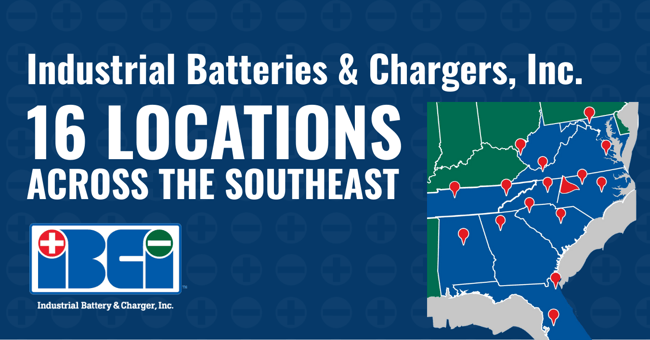
Alabama - Birmingham
Florida - Jacksonville and Lakeland
Georgia - Atlanta
Maryland - Hagerstown
North Carolina - Charlotte, Conover, Kernersville, and Wilson
South Carolina - Camden and Greer
Tennessee - Knoxville and Nashville
Virginia - Richmond and Salem
West Virginia - Nitro

Stay informed by subscribing to the Electric Forklift Fleet Power blog.
Explore expert insights, safety tips, and power system guidance to help keep your electric forklift fleet efficient, productive, and running strong.
How long should a forklift battery last? It depends on your application, shifts and charging windows, and none of that is on the spec sheet. Here’s...
Discover 5 traits of the best industrial battery suppliers and learn how to choose a partner that keeps your forklift batteries and operations...
Discover why EnerSys recognized IBCI as its top Motive Power representative and how the company continues to deliver trusted power solutions.